Now Also operating from our new yard in Alice Springs. Our address is 3/31 Elder Street Ciccone 0870.


When Is Hydro Excavation Worth the Cost on Darwin Civil Projects?
July 17, 2026
Selecting the right excavation method can significantly affect project costs, safety and overall efficiency, particularly where underground services, restricted access or difficult ground conditions are involved. As demand for hydro excavation in Darwin continues to grow, contractors and asset owners are increasingly using this non-destructive method for work that requires greater precision and a lower risk of damaging buried infrastructure. JSM Civil provides hydro excavation services designed to support safer and more controlled civil works.
Although hydro excavation can involve a higher initial cost than mechanical digging, the hourly or daily rate does not provide a complete picture of its value. The more useful comparison is the total project cost, including the risk of service strikes, delays, reinstatement, additional traffic control and rework.
This article explains when hydro excavation is likely to deliver a strong return on investment, the site conditions that make it particularly valuable and the situations where traditional excavation or a combination of methods may remain more practical.
Hydro excavation quotes can initially appear more expensive than hiring an excavator and operator. However, excavation costs should be assessed across the whole project rather than by comparing plant rates alone.
Mechanical excavation may be faster when working in open ground with no nearby services. On constrained, service-dense or operational sites, however, the consequences of damaging an asset or excavating a larger area can outweigh the initial savings.
Hydro excavation may reduce total project costs by:
The method therefore offers the greatest financial value where accuracy, disruption and risk matter more than the volume of material removed per hour.
Hydro excavation becomes particularly valuable when underground services are congested, poorly documented or potentially hazardous.
Traditional excavator buckets use metal teeth that can damage power, water, gas, telecommunications and drainage infrastructure. Hydro excavation instead uses pressurised water to loosen the ground before a vacuum removes the resulting material.
This does not eliminate all excavation risk. Service locating, site planning, appropriate water pressure, trained operators and safe excavation procedures are still required. However, the method can significantly reduce the likelihood of severe contact with buried assets when compared with unrestricted mechanical digging.
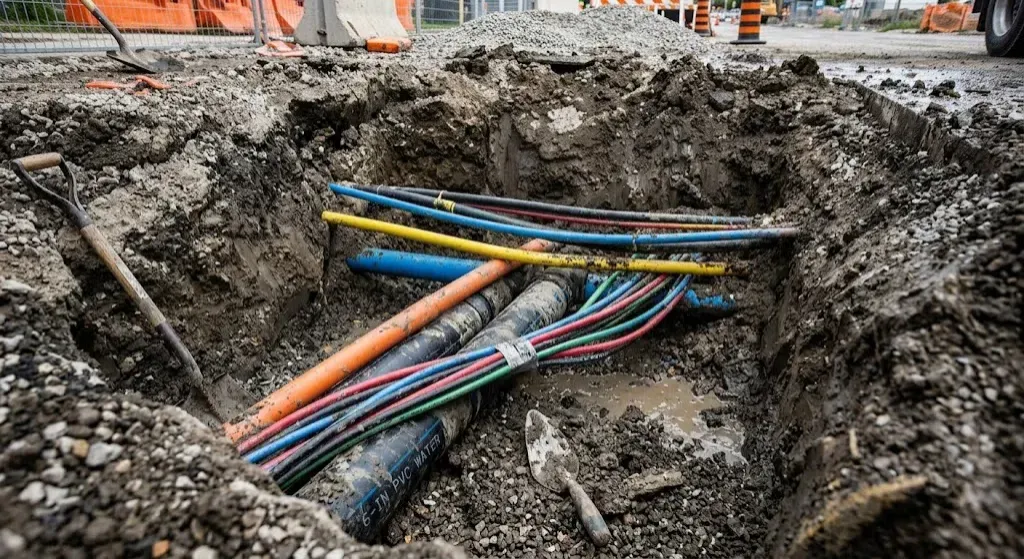
A damaged underground service can create costs far beyond the physical repair. Depending on the asset and location, a strike may result in:
On projects with high-consequence infrastructure, avoiding a single moderate service incident may offset the additional cost of hydro excavation.
The financial case is especially strong around:
The more severe the consequences of an asset strike, the easier it becomes to justify non-destructive excavation.
Service strike risks increase where several utilities share a narrow corridor or where records cannot be relied upon.
Hydro excavation should be considered where projects involve:
Before You Dig Australia information, service plans and surface markings remain essential, but they do not physically confirm an asset’s exact position or depth. Targeted potholing allows contractors to expose services at known conflict points and verify their location before construction proceeds.
Design drawings, surveys and utility records may not always reflect what is underground. Warning signs include:
Using mechanical equipment to search for a service introduces unnecessary risk. Hydro excavation allows contractors to expose the area progressively, confirm what is present and adjust the construction approach before larger equipment is introduced.
Hydro excavation can be cost-effective where conventional machinery cannot easily reach the excavation point or where surrounding surfaces would be expensive to restore.
Excavators require room to enter, turn, operate and maintain safe clearances. These requirements can make mechanical digging difficult in narrow laneways, side access routes, congested compounds and built-up areas.
A vacuum truck may remain parked in a suitable location while hoses extend to the excavation zone. The hoses can pass through gates, around structures and between obstacles without requiring extensive access modifications.
This can be useful in:
The smaller work footprint may also reduce the need to remove fences, landscaping or other site features simply to provide machinery access.
The cost of reinstatement can exceed the excavation cost itself, particularly where work is required through finished or specialised surfaces.
These may include:
Mechanical trenching often requires wider saw cuts, greater material removal, more backfill and larger areas of pavement replacement. It may also disturb adjacent slab edges, paving, tree roots or landscaped areas.
Hydro excavation creates smaller and more controlled openings, helping reduce the amount of surface material that must be removed and replaced. Where suitable, potholing may also support a keyhole excavation approach, allowing buried services to be verified through a compact opening rather than a wide trench.
This can lower costs associated with:
Hospitals, schools, shopping centres, airports, transport corridors and industrial facilities often need to remain operational while excavation work is completed.
In these environments, the excavation method must account for:
Hydro excavation can support more targeted work with immediate spoil removal, reducing the need for large stockpiles or wide excavation zones. This can help maintain access and minimise disruption, even where the plant rate is higher than that of an excavator.
Ground conditions can influence excavation speed, stability, accuracy and the likelihood of damaging buried infrastructure.
Darwin projects may encounter a variety of soil and site conditions, including seasonally saturated ground, reactive soils, mixed fill and loose granular materials. Hydro excavation may provide better control in some of these conditions, although its suitability should always be assessed for the specific site.
Saturated clays and silts may appear stable before suddenly slumping or collapsing. Mechanical excavation can disturb a wider area and may place additional pressure on trench walls or nearby services.
Hydro excavation allows material to be removed in a controlled manner with less vibration and impact than conventional digging. It can therefore be useful when exposing services near:
However, hydro excavation does not remove the need for trench safety controls. Appropriate shoring, benching, battering, access provisions and exclusion zones may still be required depending on the excavation depth and ground conditions.
Reactive clays can expand and contract as moisture levels change. Mechanical buckets may break away larger sections than intended, resulting in over-excavation or the undermining of nearby pavements and structures.
Hydro excavation can offer more controlled soil removal around specific assets or design points. This helps preserve excavation dimensions and reduces unnecessary disturbance outside the required footprint.
The method may be particularly valuable where the excavation must remain close to:
Brownfield and established urban sites often contain layers of imported fill, construction debris, redundant services and undocumented infrastructure.
Excavator buckets may snag cables or pipes hidden within compacted fill. They may also drag shallow services across the excavation before the operator realises contact has occurred.
Hydro excavation enables progressive visual confirmation as the ground is removed. This can provide:
Where asbestos-containing materials or other hazardous substances are suspected, work should stop so the site can be assessed and appropriate controls introduced. Standard hydro excavation procedures should not be assumed to be suitable for hazardous materials without specialist planning.
Loose sands and granular soils may collapse into mechanically excavated trenches, increasing the amount of material that must be removed and replaced.
Hydro excavation may be useful for narrow, targeted tasks such as:
By limiting disturbance beyond the intended footprint, the method can reduce spoil volume, replacement material and the likelihood of destabilising surrounding ground.
The additional cost of hydro excavation may be justified where delays have a high financial or operational impact.
A project with a flexible programme and low-risk surroundings may be able to absorb minor interruptions. In contrast, work completed under road closures, rail possessions, shutdown periods or limited site access may have very little room for delay.
Hydro excavation can improve programme certainty by exposing services before other crews and equipment are mobilised.
This helps project teams:
Where a project has no programme float or includes liquidated damages for late completion, losing even one shift may cost more than the difference between hydro and mechanical excavation.
This can be particularly important during:
Hydro excavation is not always the main excavation method. In many projects, its best use is to gather accurate information before bulk work begins.
Targeted test holes can confirm:
Accurate verification allows designers, supervisors and plant operators to make better decisions before construction reaches a critical point.
Hydro excavation generally produces smaller openings and removes excavated material directly into a vacuum tank. This can reduce surface disturbance and the need for temporary spoil stockpiles.
On constrained sites, immediate spoil removal can improve housekeeping and free up valuable working space.
However, hydro excavation creates slurry that must be contained, transported and disposed of correctly. Disposal requirements vary depending on the soil, the site and the potential for contamination.
The total cost assessment should therefore consider:
Where disposal facilities are distant or liquid waste restrictions apply, slurry management can reduce the financial advantage of hydro excavation.
Hydro excavation is precise and well suited to high-risk work, but it is not the most efficient method for every project.
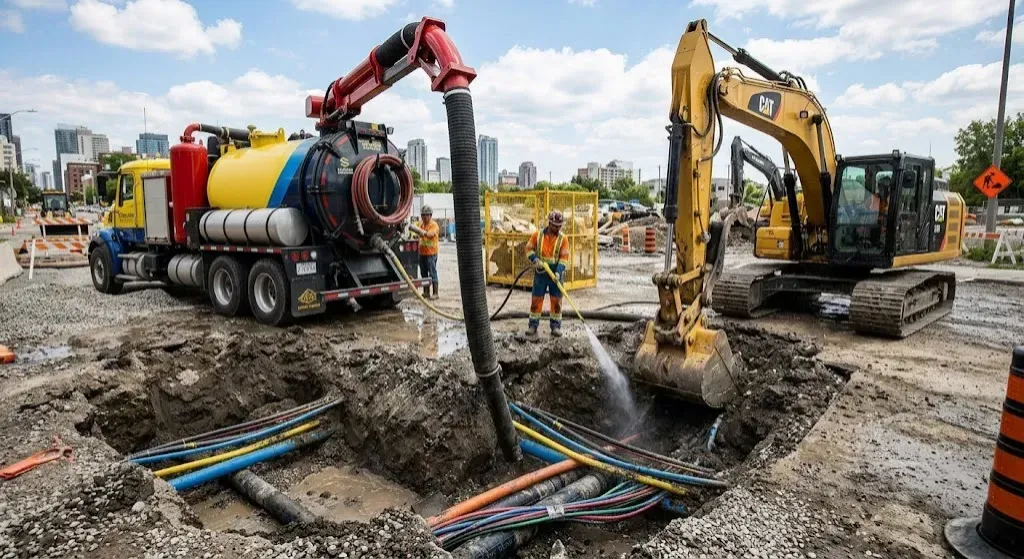
Hydro excavation is designed for selective removal and service exposure, not for moving thousands of cubic metres of material.
Mechanical plant remains more suitable for:
On open sites with no congested services, excavators, loaders and scrapers can move material much faster and at a lower unit cost.
Using hydro excavation for bulk earthworks would slow production and increase water, transport and disposal costs without providing a proportional safety or accuracy benefit.
Mechanical excavation may also be sufficient on greenfield projects where:
In these situations, the cost of vacuum trucks and slurry disposal may exceed the value of the additional risk reduction.
Hydro excavation can become slower in highly consolidated soil, cemented material or rock. Pressurised water may struggle to break the material efficiently, increasing fuel and labour costs.
Mechanical breakers, rock saws or excavators may be required where the material cannot be removed productively with water alone.
Hydro excavation may still be useful for exposing services before mechanical breaking begins, but it may not be suitable as the primary removal method.
The method may be less practical where:
In these cases, mechanical excavation combined with targeted service proving may provide a better balance between risk, speed and cost.
Many projects do not need to choose exclusively between hydro excavation and mechanical digging. A hybrid approach can combine the safety and accuracy of non-destructive excavation with the productivity of conventional plant.
A common sequence involves:
This approach directs hydro excavation resources to the parts of the project where they provide the greatest value.
It can reduce the risk of service strikes without unnecessarily slowing bulk excavation or increasing slurry disposal costs across the entire site.
Before selecting an excavation method, contractors and asset owners should consider the potential consequences of using the wrong approach.
Important questions include:
The method with the lowest plant rate is not necessarily the method with the lowest final cost. The most economical choice is the one that controls the project’s most significant risks while maintaining practical production rates.
Hydro excavation provides the greatest value where precision, service protection, restricted access and disruption control are critical. Its benefits are particularly clear around congested underground utilities, sensitive surfaces, operational facilities and locations where one service strike or lost shift could create substantial costs.
Traditional mechanical excavation remains the more efficient choice for large open areas, bulk earthworks and straightforward sites with clearly identified services. On many civil projects, using hydro excavation to expose critical assets before mechanical excavation begins offers the most effective balance of safety, productivity and cost.
By assessing the total project risk rather than comparing hourly rates alone, contractors and asset owners can select an excavation method that supports safer work, fewer delays and more predictable delivery. JSM Civil provides hydro excavation services in Darwin to help civil projects locate buried assets, manage constrained excavation areas and complete work with greater accuracy and control.


