Now Also operating from our new yard in Alice Springs. Our address is 3/31 Elder Street Ciccone 0870.


How Deep Can Horizontal Directional Drilling Go?
August 28, 2026
Horizontal directional drilling (HDD) has transformed how utilities, pipelines and underground services are installed with minimal surface disruption. There is no universal maximum depth for HDD, as achievable depth depends on ground conditions, pipe size, bore length, rig capacity, tracking accuracy and existing infrastructure. Hydro excavation in Darwin can also help verify underground services before the bore path is established.
JSM Civil understands that drilling deeper is not always the best solution. Geology, bore design, drilling fluid management, site access and equipment capabilities all influence how deep a bore can safely and efficiently go, particularly when working beneath roads, rail lines, waterways or existing services.
Understanding these factors early allows the bore depth to be planned around the site's specific requirements rather than simply the limits of the equipment. This helps balance safety, constructability, cost and the need to maintain adequate clearance and protection throughout the installation.
Ground conditions and geology are major factors in determining how deep HDD can safely and efficiently go. Soil strength, groundwater, permeability and changes in geological conditions can affect bore stability, drilling fluid requirements, steering accuracy and the risk of complications such as bore collapse or inadvertent returns.
A geotechnical investigation helps identify these conditions before drilling begins, allowing the bore profile, equipment and drilling methods to be matched to the ground. The same HDD rig can have very different depth capabilities depending on whether it is working through stable clay, loose sand or fractured rock.
Cohesive clays and stiff silts can provide good bore stability when drilling fluids and pressure are properly controlled. However, very soft or sensitive clays may become unstable as depth increases, creating a risk of bore enlargement, collapse or ground movement.
Highly compressible materials like peat and organic soils can be challenging because they may deform under drilling pressure. These conditions can limit practical drilling depth and may require changes to the proposed alignment or construction method.
Loose sands and gravels provide less natural support to the bore walls, increasing reliance on drilling fluid to maintain stability and transport cuttings. Permeable ground can also absorb drilling fluid, making it harder to maintain circulation and control pressure.
Coarse gravels, cobbles, loose fill and highly variable made ground can further complicate drilling by increasing the risk of bore deviation, tool damage, obstructions and fluid loss. Where these conditions are identified, a more conservative bore depth or alternative drilling approach may be required.
Competent, relatively uniform rock can allow deep HDD installations, but fractured or weathered formations can create challenges. Open fractures may allow drilling fluid to escape, reducing circulation and increasing the risk of inadvertent returns.
Mixed ground conditions can be even more difficult because the drilling system must accommodate changes between soil and rock. Tool selection, steering and fluid management must account for the most challenging sections, meaning achievable depth is often determined by the least favourable ground conditions along the alignment.
.webp)
Bore length and diameter directly affect the practical depth of an HDD installation. As either increases, so do the demands on the drill rig, drill string, drilling fluid system and product pipe. These factors therefore need to be considered together when establishing a safe and constructible bore profile.
A deeper bore requires longer entry and exit curves to maintain the required bend radius. Increasing bore length also increases friction and pullback forces, placing greater demands on the drill string, equipment and product pipe.
Longer bores can also create greater drilling fluid pressure losses and make circulation more difficult. If the bore becomes excessively long, these factors can make additional depth impractical even when the rig has sufficient power.
Larger bores require greater volumes of drilling fluid to maintain stability and transport cuttings to the surface. This can increase pressure within the bore and raise the risk of fluid loss or inadvertent returns in weaker or fractured ground.
The bore must also be appropriately sized for the product pipe and installation method. Increasing diameter without considering ground conditions and fluid requirements can therefore restrict the practical depth.
Depth should not be considered separately from bore length and diameter. A deeper profile may require a longer alignment, while a larger bore can increase fluid and equipment demands.
A suitable design considers:
The objective is to achieve the required depth without unnecessarily increasing construction risk, equipment demands or project costs.
Existing underground services can influence the depth and alignment of an HDD bore. Water mains, gas lines, electrical cables, telecommunications and drainage systems all need to be identified and protected before drilling begins. In congested areas, the bore may need to go deeper to pass beneath existing assets while maintaining the required separation.
Before finalising the bore profile, service locations should be verified using utility records, site investigations, locating equipment and controlled potholing or vacuum excavation. Accurate information about service positions and depths allows the HDD path to be designed with appropriate clearance and reduces the risk of damaging critical infrastructure.
Before You Dig Australia recommends following the Five Ps of safe excavation, including obtaining utility plans, engaging a skilled locator and verifying asset locations through approved potholing methods.
A deeper bore may be necessary when:
NT WorkSafe provides guidance for working near underground infrastructure, including contacting the relevant infrastructure operator to establish its requirements before excavation begins.
However, greater depth is not automatically safer. Increasing depth can lengthen the bore, increase steering difficulty and raise drilling fluid and equipment demands. The final profile should provide the necessary separation while remaining suitable for the site's ground conditions and HDD capabilities.
Site access and bore geometry can place practical limits on achievable HDD depth. The available working area, rig position, entry and exit locations, pipe handling requirements and surrounding infrastructure all influence the final bore profile.
A well-planned profile allows the drill to reach the required depth without creating unnecessary bending stress, drilling fluid challenges or tracking difficulties.
The available space affects where the rig can be positioned, the entry angle and the length of the bore. Restricted sites may require a steeper entry angle to reach the required depth within a shorter distance, increasing stress on the drill string and product pipe.
Space is also needed for rig setup, drilling fluid equipment, drill rods and product pipe preparation. If access restrictions prevent larger equipment from reaching the site, the achievable bore length and depth may also be reduced.
Entry and exit angles must balance the required depth with pipe stress, bend radius and available space. A flatter angle requires a longer approach to reach the target depth, while a steeper angle can increase curvature and stress near the entry point.
The profile should provide:
An HDD bore typically includes an entry curve, a section at or near the required depth and an exit curve. The length and curvature of these sections depend on the pipe, ground conditions, required clearances and available working area.
Property boundaries, roads, existing infrastructure or restricted access can prevent the longer curves needed for a deeper profile. The bore path design should therefore consider depth alongside alignment, bend radius and site constraints.
The capacity of the HDD rig and the accuracy of its tracking system influence how deep a bore can safely and reliably go. A suitable rig needs enough pullback force, torque and hydraulic capacity to handle the bore's length, diameter and ground conditions. At the same time, the drilling head must be accurately tracked to maintain the designed alignment.
Correctly matching the drilling rig to the project and soil type helps ensure the equipment has the power, tooling and operational capacity required for the proposed bore.
Greater depth increases the forces placed on the drill string and equipment. The rig, therefore, needs sufficient:
Downhole tooling must also suit the formation. Hard rock and difficult ground may require specialised cutting heads, mud motors or other equipment, adding to the technical demands of a deep bore.
Accurate tracking becomes increasingly important as bore depth and length increase. Locating systems can become less effective at greater depths or where underground infrastructure and ground conditions interfere with the signal. Deeper installations may therefore require advanced tracking methods that provide reliable downhole information.
Small steering errors can become significant over a long bore, potentially affecting required clearances or causing the bore to move outside its permitted alignment. Maximum depth is therefore determined by the combined capabilities of the rig, drill string, downhole tooling and tracking system rather than rig power alone.
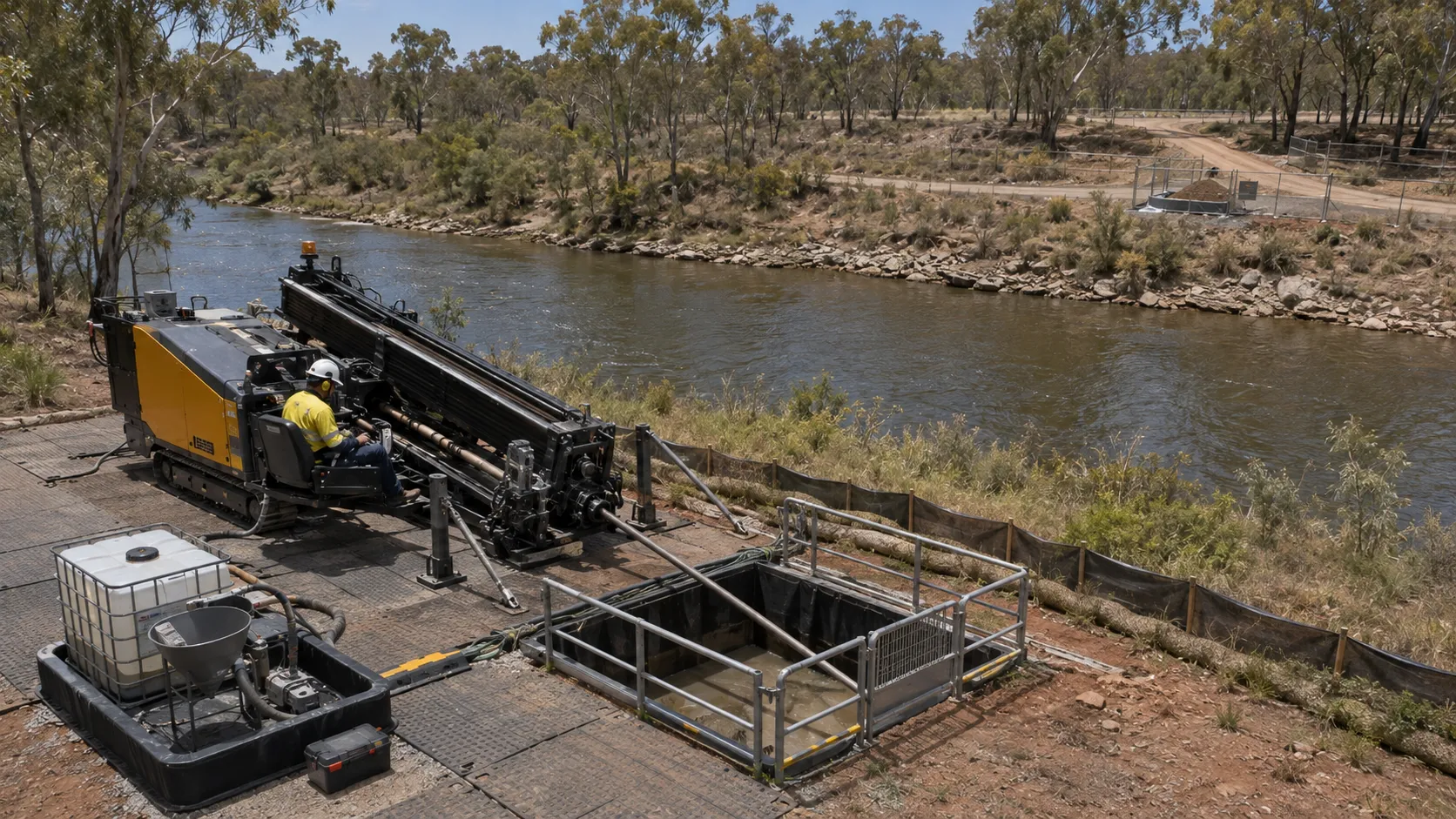
The required depth of an HDD bore depends on what the installation needs to pass beneath and the level of protection and separation required. Major road, rail and waterway crossings require more carefully controlled profiles than straightforward residential or utility connections, while existing underground services can increase depth requirements on almost any project.
The final depth should be established during design based on ground conditions, existing infrastructure, authority requirements, bore geometry and the requirements of the installation.
Depth should therefore be determined by the specific requirements of the project rather than by applying a standard figure to every HDD installation.
There is no universal minimum depth for every HDD crossing. The required cover depends on the obstacle, ground conditions, existing services, product being installed and requirements set by the relevant authority or asset owner.
Avoiding common mistakes when planning underground services, including incorrect depths and insufficient clearances, can reduce the risk of damage, delays and costly rework.
The bore should be deep enough to protect the installation from surface loading, future excavation and other foreseeable risks while maintaining safe separation from existing infrastructure.
Required cover is only one part of determining HDD depth. Entry and exit angles, bend radius, bore length, ground conditions and existing service locations all affect the final alignment.
Before drilling, critical underground services should be accurately located and verified where necessary. Hydro excavation can help expose services with reduced risk of mechanical damage, providing information that allows the HDD design to maintain appropriate clearances without creating unnecessary bore depth.
Soil stability and drilling fluid management can determine how deep an HDD bore can safely go. As depth and bore length increase, maintaining bore stability, removing cuttings and controlling drilling fluid pressure become more challenging.
If the surrounding ground is unstable or fluid properties are poorly matched to the formation, the risk of bore collapse, fluid loss or inadvertent returns can increase.
Geotechnical investigation and monitoring of drilling pressures and fluid returns can help identify changing ground conditions and allow the drilling approach to be adjusted. The objective is to maintain a controlled balance between bore stability, cuttings removal and pressure management rather than simply increasing drilling fluid pressure as depth increases.
A deeper HDD bore is only beneficial when it provides a clear engineering or practical advantage. Additional depth may be needed to maintain separation from existing services, roads, railways, waterways or unsuitable ground, but it can also increase bore length, drilling pressures, steering demands and project costs.
The aim is to achieve the minimum practical depth that meets the project's safety, clearance and installation requirements.
A deeper profile may be required when:
On congested sites, hydro excavation can help verify the position and depth of critical underground services before finalising the bore profile.
If the required clearances and cover can be achieved safely at a shallower level, there may be little benefit in drilling deeper. Excessive depth can require longer entry and exit curves, increase drilling fluid requirements and pullback forces and make tracking and steering more difficult.
Depth should be increased only where the additional cover or separation provides a meaningful benefit to the installation.
Determining HDD depth involves more than selecting a target measurement. The proposed bore profile should be assessed against the site's physical conditions, installation requirements and construction limitations before drilling begins.
A typical design review considers:
This approach ensures that depth is treated as part of an overall engineering design rather than as a standalone target.
The achievable depth of horizontal directional drilling is influenced by more than the capability of the drill rig. Ground conditions, bore length and diameter, existing services, bore geometry, drilling fluid management and tracking accuracy all determine whether a deeper installation is safe, practical and cost-effective.
JSM Civil understands that successful HDD projects require careful planning around the specific conditions of each site. Greater depth may be necessary to achieve adequate cover or clearance, but drilling deeper than required can increase complexity, cost and construction risk.
With appropriate investigation, equipment selection and bore design, HDD depth can be managed as part of a controlled installation strategy. The best bore profile is not necessarily the deepest one, but the one that provides the required protection and separation while remaining safe, constructible and cost-effective.


